The Australia Unemployment Rate April 2026 surprised financial markets after rising to 4.5%, above the expected 4.3%. The weaker labour market data immediately impacted the Australian Dollar and increased speculation that the Reserve Bank of Australia (RBA) may slow down future monetary tightening.
According to data released by the Australian Bureau of Statistics (ABS), Australia’s economy lost jobs during April instead of adding new employment as analysts had forecast. The unexpected results created volatility across forex markets, particularly in AUD currency pairs.
For traders, the latest Australia Unemployment Rate April 2026 figures highlight why employment data remains one of the most important macroeconomic indicators in global financial markets.
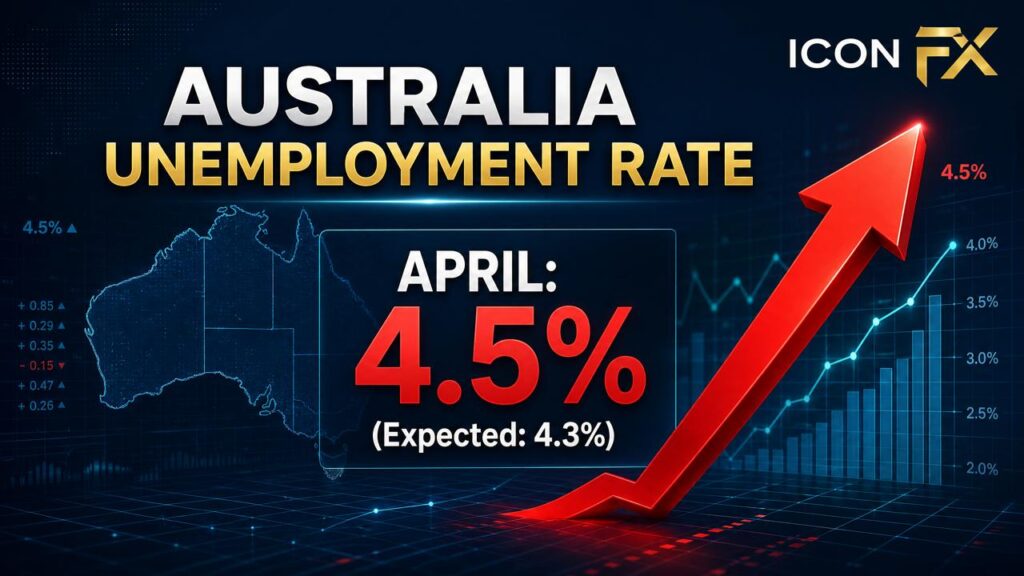
The latest ABS report showed the unemployment rate increasing from 4.3% in March to 4.5% in April 2026. Markets had expected the rate to remain stable near 4.3%, making the result a negative surprise for investors and economists alike.
At the same time, Australia recorded a sharp decline in employment numbers. Instead of adding 17.5K jobs as forecasted, the economy lost approximately 18.6K positions during the month.
Key figures from the Australia Unemployment Rate April 2026 report included:
The report suggests Australia’s labour market may be slowing after several years of resilience despite higher interest rates and slowing global economic conditions.
The Australian Dollar weakened shortly after the Australia Unemployment Rate April 2026 data release. Traders viewed the weaker labour market as a signal that economic momentum may be slowing faster than expected.
Employment data matters heavily in forex trading because central banks monitor labour market strength when deciding interest rate policy. If unemployment rises and hiring slows, policymakers may become more cautious about raising rates further.
Following the report, AUD/USD moved lower as investors reduced expectations for additional aggressive rate hikes from the Reserve Bank of Australia.
The Australian Dollar is often considered a risk-sensitive currency because it is closely tied to global growth, commodities, and investor sentiment. Weak domestic economic data can therefore create sharp market reactions.
Related internal article:
[How Geopolitical Tensions Affect Forex Trading Strategies]
For forex traders, the Australia Unemployment Rate April 2026 report may signal increased volatility ahead across AUD pairs.
Here’s why the report matters:
Markets may now expect the RBA to adopt a softer stance if employment conditions continue weakening.
Unexpected economic data often creates rapid price swings in forex markets, especially during major economic releases.
If inflation also begins slowing, expectations for future rate hikes could fall even further.
Australia’s economy remains heavily linked to China, commodities, and global growth trends. Traders will continue monitoring external risks alongside domestic data.
For beginner traders, economic releases like the Australia Unemployment Rate April 2026 demonstrate how macroeconomic news can influence currency prices within seconds.
Related internal article:
[Forex Trading in 2026: Are AI and Algorithms Making Markets Harder to Trade?]
The weaker labour market data arrives during a critical period for the Reserve Bank of Australia.
The central bank has been trying to balance persistent inflation pressures with slowing economic activity. Rising unemployment could reduce pressure for further aggressive tightening, particularly if consumer spending and inflation also soften over the coming months.
However, policymakers may still remain cautious because inflation in Australia has not fully returned to target levels.
This means traders should continue monitoring:
The Australia Unemployment Rate April 2026 report delivered a major surprise to markets by rising to 4.5% and showing a sharp decline in employment growth.
The weaker-than-expected labour data pressured the Australian Dollar and increased uncertainty around future Reserve Bank of Australia policy decisions.
For forex traders, the report is another reminder of how closely economic indicators influence currency market sentiment, volatility, and trading opportunities.
As markets now shift focus toward inflation and future RBA commentary, traders should prepare for continued volatility in AUD-related currency pairs over the coming weeks.
 Copyright © 2026 IconFX
 Español
  English
  Русский
  Français